BookGusto
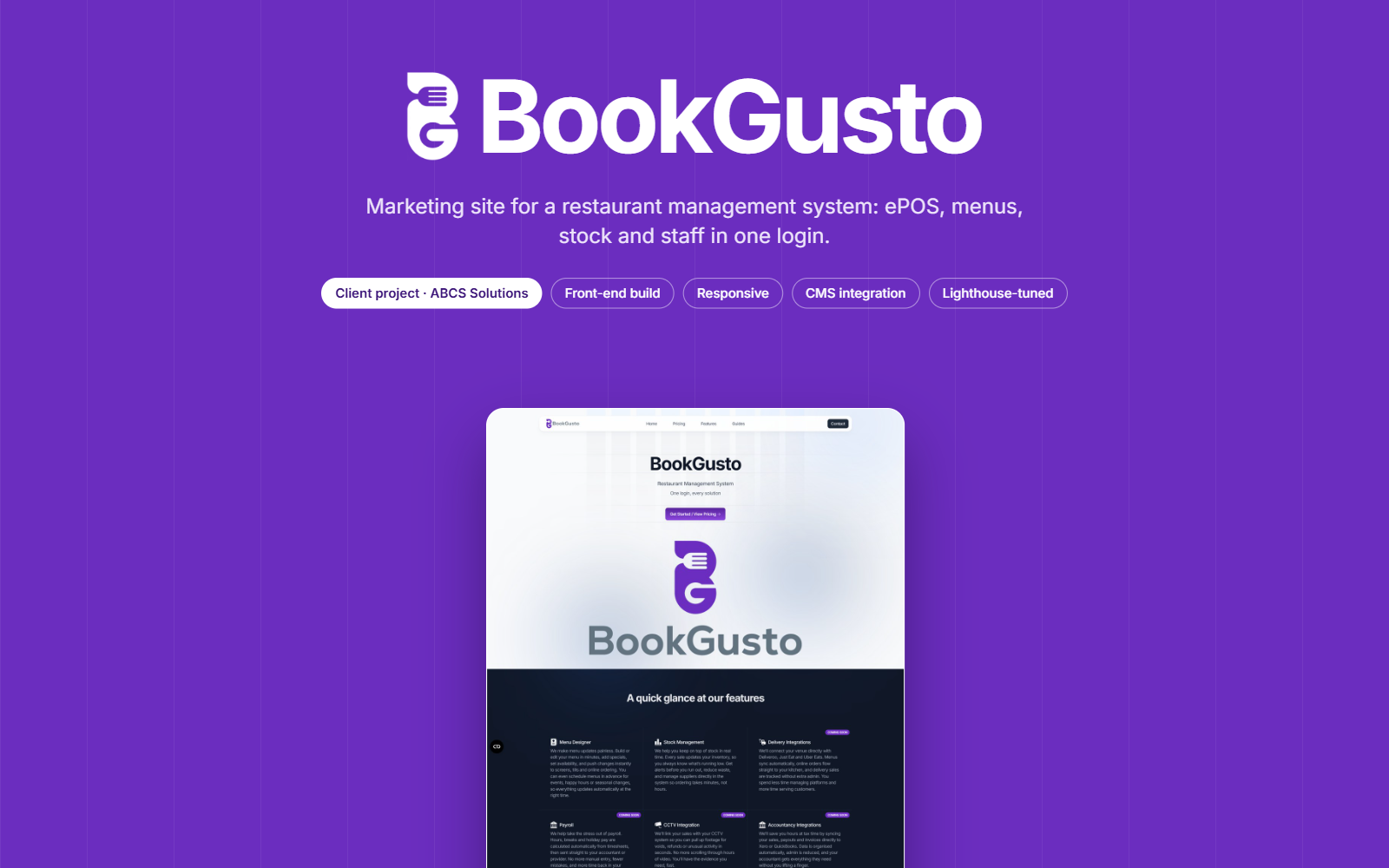
A fast, SEO-focused marketing site for a restaurant management system, with live pricing from Stripe and content the team edits in Strapi.
- Role
- Frontend developer
- Year
- 2023
- Status
- Shipped
The problem
BookGusto is a restaurant management system that brings ePOS, menus, stock and staff into one login. Before launch it needed a marketing site that explained the product clearly, ranked well in search and loaded fast on the phones restaurant owners actually use.
Pricing was the awkward part. Plans, prices and what each tier includes were already set up in Stripe for billing. Copying them by hand into the website would mean two sources of truth, and sooner or later the site would advertise a price or feature that the checkout didn't match. The rest of the copy also needed to change often without waiting on a developer.
What I built
Pricing pulled straight from Stripe
The pricing page reads products and prices from Stripe, along with metadata on each product such as the tier name, its feature list and which plan to highlight. When a price or tier changes in Stripe, the website follows, so the site and the checkout can't drift apart.
Content managed in Strapi
Page copy, the feature overview and the guides section live in Strapi, so the team can update wording, add guides and mark features as coming soon without a code deploy.
Feature overview
A scannable grid covering menu designer, stock management, delivery integrations, payroll, CCTV and accountancy integrations, with clear coming-soon labels so visitors know what's live today.

Responsive, accessible front end
Built from the designers' layouts and tuned to work cleanly from small phones up to wide desktops, with semantic markup and proper heading structure throughout.
Decisions
Decision 1
Stripe as the source of truth for pricing
Rather than storing prices in the CMS, the site reads them from Stripe, and the extra tier details live in Stripe product metadata. Billing and marketing share one set of data, and nobody has to remember to update the website when pricing changes.
Decision 2
Strapi for everything that isn't pricing
A headless CMS let the team own the copy and guides while I owned the front end. Keeping pricing out of Strapi meant each system had one clear job.
Decision 3
Pre-rendered pages for speed and SEO
Pages are rendered ahead of time with Next.js rather than built in the browser, so search engines get complete HTML and visitors get a fast first paint. Content from Strapi and Stripe is refreshed in the background instead of fetched on every visit.
Decision 4
SEO built in, not bolted on
Every page gets its own title, description and Open Graph tags, plus structured data, a sitemap and clean URLs. The guides section gives the site useful, indexable content beyond the sales pages.
Decision 5
A strict performance budget
Optimised and correctly sized images, self-hosted fonts and minimal client-side JavaScript kept the site scoring near-perfect on Lighthouse. For a product pitched on making restaurants run smoothly, a slow website would undercut the message.
Stack
- Next.js
- Pre-rendered pages with background refresh, so the site is fast and fully indexable while still pulling live content and pricing.
- Tailwind CSS
- Quick, consistent styling from the design system without shipping a heavy CSS bundle.
- Strapi
- Headless CMS so the team can edit copy, features and guides without a developer.
- Stripe
- Products, prices and tier metadata feed the pricing page, keeping it in sync with billing.
Outcome
The marketing site shipped with pricing that stays in step with Stripe, content the team can manage themselves, and near-perfect Lighthouse scores. The wider restaurant management system it was built to support didn't move past that stage, but the site did its job: a fast, search-friendly front door that's cheap to keep up to date.
Need a fast, search-friendly website your team can update themselves?
Tell me what you're trying to build and I'll tell you honestly how I'd approach it.